bench — a prototype verification loop
The goal of this tool is to better inform your review of the diff. It does that via a prediction the person shipping writes before anything runs, to check that they understand what they're shipping. The human produces the claims and the machine records the reality. Below you can find a real example from building this tool, and the prediction missed. Can you spot where?
RouteSpec should run against both the logic within TaskService and the DoobieTaskRepo, via PostgresSuite. I expect all 14 cases to pass. Its possible an edge case exists around the FSM, with (Assigned, Assign) => Assign yielding unclear but unexpected behavior.
locked 2026-08-09 15:54:46Z · write-once · no edits after this point
TaskTransitionSpec — the suite whose entire job is
exhaustively testing FSM transitions. The prediction never mentions it.
The gap in the map sits exactly where the author's confidence was lowest. Those are the same four tests.
Captured output — key lines, ANSI stripped
Test run verificationloop.domain.TaskTransitionSpec finished: 0 failed, 0 ignored, 4 total 0.018s
Test run verificationloop.http.RoutesSpec finished: 0 failed, 0 ignored, 14 total 2.99s
[info] Passed: Total 18, Failed 0, Errors 0, Passed 18
[success] Total time: 8 s
Check — submitted 16:15:41Z
The TaskTransitionSpec is clear about the FSM, and has coverage for exactly the ambiguous/error prone case I called out.
Induced failure — superseded, and what replaced it · 2026-08-23
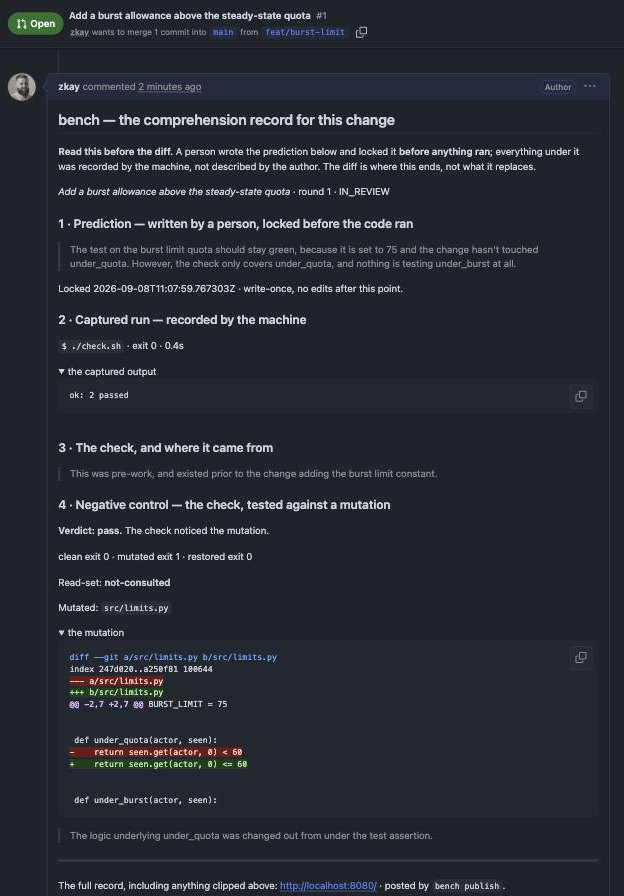
The fourth step above asked the author to break the check by hand and describe what happened. That is now a machine's job: one command runs the check clean, applies a mutation that should break it, runs it again, and restores the tree — three captures, one verdict. Below is the first time it was pointed at this project's own test suite, on a later task.
The mutation — delete the role check that stops a senior claiming a junior's task:
-      case Right((_, actor)) if actor.role != Role.Junior =>
-        ServiceError.Forbidden("only a junior may claim a task").asLeft[Task].pure[ConnectionIO]
The prediction, locked before the run — it commits to an answer and names how it could be wrong:
Prediction, committed: B is red. Stated risk, committed: if B is green, it is the assignedTo guard covering for the role guard, and the test needs isolating rather than the code needing fixing.
What the run recorded — the risk, not the prediction:
clean     exit 0   Test run verificationloop.http.RoutesSpec finished: 0 failed, 0 ignored, 25 total 3.989s
mutated   exit 0   Test run verificationloop.http.RoutesSpec finished: 0 failed, 0 ignored, 25 total 3.882s
restored  exit 0   Test run verificationloop.http.RoutesSpec finished: 0 failed, 0 ignored, 25 total 3.912s
The guard was deleted and the suite did not notice: 96/96 either way. Verdict: fail — not the code failing, the check failing. The review said so and sent it back:
The control came back fail: B green, 96/96, the check did not notice the role check being deleted. That is a real gap, not a flaky run — RoutesSpec asserts the 403 status but not which guard produced it, and assignTask means a senior is never the assignee, so the assignment guard answers with the same status. Assert the message and run the control again.
Then the same mutation, against the strengthened test — one assertion added, comparing which guard answered:
==> X verificationloop.http.RoutesSpec.rejection: only a junior may claim a task 0.035s munit.ComparisonFailException: src/test/scala/verificationloop/http/RoutesSpec.scala:391
…
values are not the same
=> Obtained
task is not assigned to this junior
=> Diff (- expected, + obtained)
-only a junior may claim a task
+task is not assigned to this junior
Red at one line in one suite, green again once the guard is restored. Verdict: pass. The mechanism submitted with it states the limit rather than the win:
The limit of the claim: this proves the suite now detects the deletion of the role check. It does not prove the ordering of the two guards is itself pinned, and no test here exercises a third role, because the seed data has two people.
The reviewer proceeds to the diff with the above in hand.
The diff is where this ends, not what it replaces.
Will the check catch it?
Four edits to a small project, four real runs. Decide whether the check goes red, then open each one. Every exit code, every line of output and every verdict below was recorded by a bench control run; nothing here is illustrative, and one of the four does not get an answer at all.
The checksrc/test/scala/CalcSpec.scala
class CalcSpec extends munit.FunSuite:
  test("add sums its arguments"):
    assertEquals(Calc.add(2, 2), 4)
The whole of what it testssrc/main/scala/Calc.scala
object Calc:
  def add(a: Int, b: Int): Int = a + b
Will you predict it?
The judgement on understanding is human, the motion before and after is the agent. Whether or not the person understood is declared in their prediction, and exposed through the output capture; the agent can lead them up to the moment they make their prediction, which, once locked in place, opens up the comparison to the capture. The gate holds a claimed round's work until the prediction exists.
bench init --agent writes into the project's CLAUDE.md## bench
This project uses bench. The machine steps are yours to run freely: `bench run`, `bench
control`, `bench claim`, `bench hook`, `bench status`, `bench publish`. Publish should be run
once the round is complete and the PR is open, to make the reviewer's job easier.
Bench provides no way for an agent to submit a prediction or a test on the user's behalf —
both are typed at a terminal, and `bench predict` and `bench test` refuse piped input. Never
write, edit, or suggest prediction, mechanism, or test text, including when asked.
When bench refuses for a missing prediction, stop and tell the user: they run `bench predict`
from a terminal (a new tab works), and the work continues once the prediction is locked.The file the bench init --agent command drops into your repository, with
explicit instruction not to make or suggest any prediction, mechanism, or test text. This
is what the agent reads. Notice its key line is a refusal.
bench: code has changed and no prediction is locked for round of task f1d2c3b4-0000-4000-8000-000000000001. the round cannot proceed. hand this to your human: bench predictIn a workflow with Claude Code and bench, the session was asked to make a commit, the block message arrived in context verbatim, and with the hook stopping the workflow the agent declined to write the prediction and relayed the message. What you just watched was the refusal and bench status pointing at what is needed to proceed, a staked prediction by the user. With the prediction locked, the same commit that was stopped by the hook went through clean.
The hook keys on a claim, so work done without being claimed escapes this process entirely. The gate stops input being piped, but a person could retype output from outside of the terminal, and the API will accept a POST from anything setting the header. What remains expensive is the author's prediction, but what gets cheaper is the reviewer's attention.